Self-Care

Your Body Is Seasonal: Growth Happens at the Speed of Safety

There’s a quiet pressure woven into our culture that tells us we should always be moving forward.

More productive.
More motivated.
More disciplined.
More consistent.

And when we’re not, when energy dips, when rest is needed, when things slow down, it’s easy to assume something is wrong.

But what if nothing is wrong?

What if your body isn’t failing you…

What if it’s moving exactly as it’s meant to?

Your Body Is Not Linear

We are often taught to measure progress in straight lines.

Start here. Improve steadily. Reach the goal.

But your body doesn’t operate that way.

Your body is seasonal.

There are times of energy and outward movement.
Times of rest and restoration.
Times of processing and integration.
Times when things feel quiet, even stagnant.

And none of those phases are mistakes.

They are part of a natural rhythm that prioritizes safety over speed.

Growth Happens at the Speed of Safety

Your nervous system has one primary job:

To keep you safe.

Not productive.
Not efficient.
Not impressive.

Safe.

When your body perceives safety, energy becomes available for growth, creativity, connection, and expansion.

When your body perceives stress or overwhelm, it shifts into protection.

Energy is redirected.
Capacity changes.
Motivation often disappears.

Not because you’re lazy.

But because your system is doing exactly what it’s designed to do.

Growth doesn’t happen through force.

It happens when the body feels safe enough to expand.

Listening Instead of Pushing

Many of us have learned to override our bodies.

To push through fatigue.
To ignore tension.
To treat rest as something we have to earn.

But the more we override, the more disconnected we become.

And eventually, the body gets louder.

Burnout.
Exhaustion.
Irritability.
Brain fog.
Loss of motivation.

These aren’t failures.

They are communication.

Your body is asking for a different pace.

Capacity Over Motivation

We often wait for motivation to return before we take action.

But motivation is unreliable when the nervous system is overwhelmed.

Capacity is the more honest measure.

Capacity asks:

What is actually available to me today?

Not what should be.
Not what it used to be.
Not what someone else can do.

Just what is real, right now.

Some days, capacity is high. Other days, it’s limited.

Both are valid.

Working with your capacity instead of against it creates sustainability.

And sustainability is what allows growth to last.

Gentle Living as a Practice

Gentle living isn’t about doing nothing.

It’s about doing what’s aligned with your current state.

It’s choosing:

  • A shorter walk instead of an intense workout

  • A quiet evening instead of forcing social energy

  • One meaningful task instead of ten rushed ones

It’s adjusting your expectations to match your nervous system, not fighting against it.

And over time, this builds something powerful.

Trust.

Rebuilding Trust With Your Body

When you begin to listen instead of override, something shifts.

Your body starts to feel safer.

And when it feels safer, it becomes more willing to open.

  • Energy returns more consistently.

  • Focus improves.

  • Creativity comes back online.

Not because you forced it.

But because you created the conditions for it.

This is body wisdom.

Not something you have to learn from outside sources.

Something you remember by paying attention.

You Are Allowed to Move Like the Seasons

There will be times when you feel expansive, energized, and ready to take on more.

And there will be times when you feel slower, quieter, more inward.

You don’t have to judge either phase.

You don’t have to rush out of one into the other.

You are allowed to move like the seasons.

  • To rest without guilt.

  • To grow without pressure.

  • To pause without panic.

Because nothing in nature blooms all year.

And neither do you.

Reflection

Take a moment to check in with yourself:

  • What season does my body feel like it’s in right now?

  • What would it look like to honor that instead of resist it?

You don’t have to change anything immediately.

Just notice.

That’s where safety begins.

You’re Not Behind: Gratitude for Your Pace, Not Someone Else’s Timeline

There’s a quiet pressure many people carry that rarely gets spoken out loud.

The feeling of being behind.

Behind in healing.
Behind in success.
Behind in clarity, confidence, relationships, finances, purpose.

Behind compared to friends.
Behind compared to strangers online.
Behind compared to who you thought you’d be by now.

That pressure can sit heavily in the chest. It can make rest feel irresponsible. It can turn growth into a race.

But here is something gentle and true:

You are not behind.

Comparison Disconnects You From Self-Trust

Comparison is subtle. It doesn’t always sound loud or jealous. Sometimes it sounds like motivation.

“I should be further by now.”
“They figured it out faster.”
“I need to catch up.”

But the moment you measure your timeline against someone else’s, you disconnect from your own body’s rhythm. You override your capacity. You stop listening.

Growth does not happen on a universal schedule.

It happens at the pace your nervous system can safely handle.

If your body has lived through stress, trauma, burnout, illness, or simply years of overextending, it will not unfold at the same speed as someone who hasn’t. That is not weakness. That is biology.

Healing happens at the speed of safety.

Growth That Happens Quietly Still Counts

Some growth announces itself. Promotions. Certifications. Milestones. Public declarations.

But much of the most meaningful growth happens internally.

Choosing not to respond the way you used to.
Resting when you would have pushed.
Saying no when you once would have said yes.
Catching a critical thought and softening it.

No one applauds those moments. They don’t show up on highlight reels.

But they matter.

The quiet growth that happens inside your nervous system is often the foundation that makes sustainable change possible. Roots grow underground long before anyone sees a bloom.

If you feel stalled, consider this:

What if you’re not stuck?
What if you’re stabilizing?

Trust Is Built Through Small, Kept Promises

Self-trust doesn’t come from dramatic reinventions.

It grows from small promises kept consistently.

Drinking water when you said you would.
Closing your laptop when you planned to.
Going to bed at the time you committed to.
Taking a walk when your body asked for movement.

Each small follow-through tells your system: I am safe with myself.

This is where discipline transforms.

Discipline does not have to mean punishment or intensity. It can mean devotion. It can mean creating structures that support you instead of shaming you.

Kind discipline sounds like:

“I will do what supports me.”
“I will not demand more than I can give.”
“I will honor my limits.”

That builds trust.

Honoring Subtle Progress

When you feel behind, it’s often because you’re only measuring visible progress.

But subtle progress may look like:

Less anxiety than last year.
More awareness than before.
Better boundaries.
A softer inner voice.
A quicker return to regulation after stress.

These are not flashy accomplishments. They are signs of nervous-system-led growth.

They are evidence that you are not stagnant.

You are integrating.

You are stabilizing.

You are learning to move forward without abandoning yourself.

Gratitude for Your Pace

Gratitude for your pace does not mean complacency.

It means respect.

It means recognizing that rushing yourself rarely produces sustainable change. It means trusting that what feels slow may actually be protective.

You are allowed to grow gradually.

You are allowed to take breaks.

You are allowed to move at the speed that keeps you intact.

You are not late. You are unfolding.

And unfolding takes time.

Reflection

Take a quiet moment and ask yourself:

  • Where am I rushing myself unnecessarily?

  • What promise can I realistically keep to myself this week?

Start there.

Not with intensity.
Not with comparison.
Just with one steady step.

That is enough.

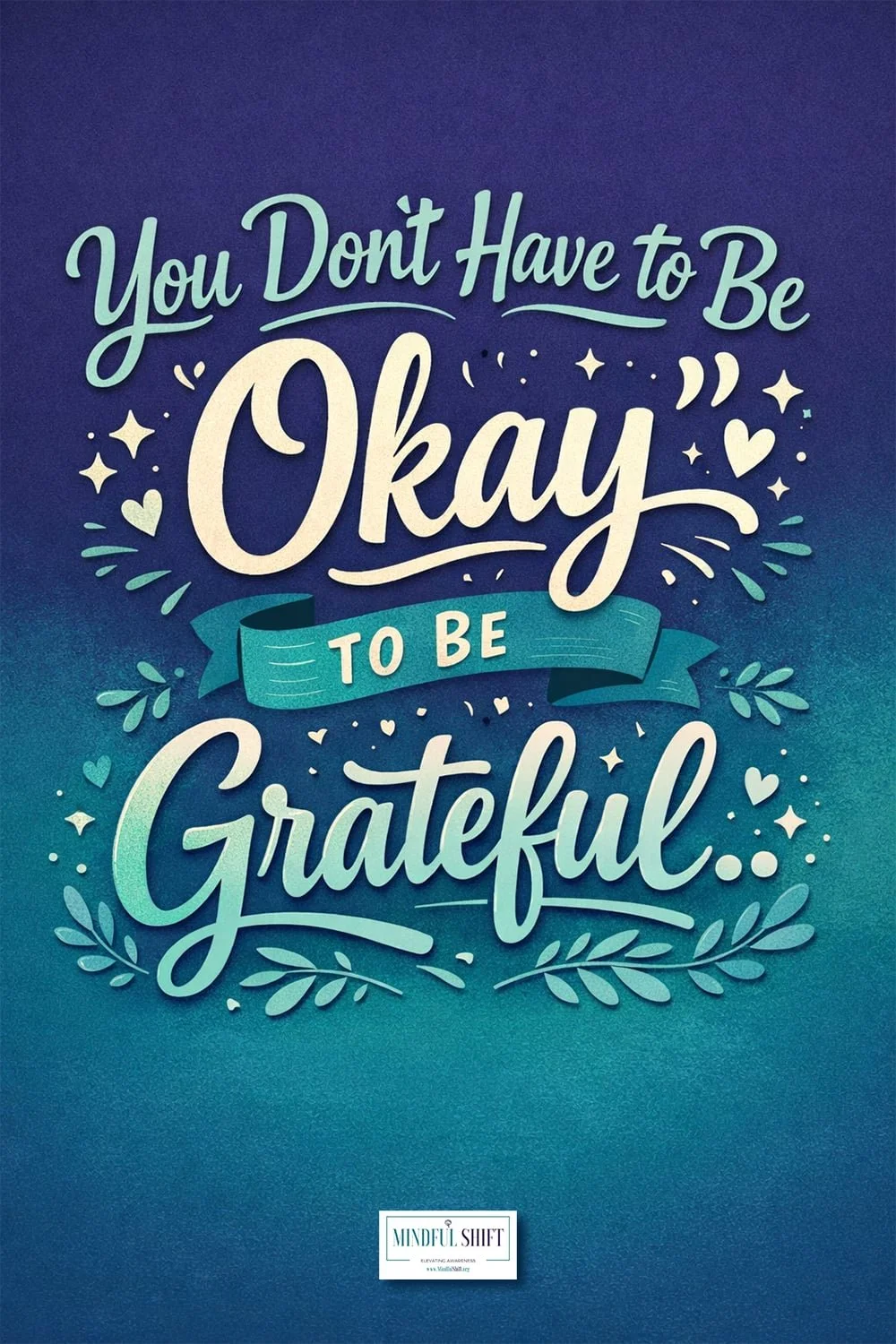
• You Don’t Have to Be “Okay” to Be Grateful

There’s a version of gratitude that gets passed around a lot. The kind that says everything happens for a reason, that insists you should be thankful because someone else has it worse, that quietly asks you to hurry up and feel better.

This isn’t that kind of gratitude.

The gratitude we’re practicing here doesn’t require you to like what you went through, or to pretend the pain shaped you into something shiny and resolved. This kind of gratitude simply acknowledges the truth: you survived something that once felt impossible.

You’re still here.

Gratitude, in this sense, is not approval. It’s an acknowledgment. It says, “This was hard, and I carried it anyway.” It honors the version of you who kept going when quitting would have made sense. The version that learned how to breathe through things they never imagined they’d have to hold.

So often, we’re taught that gratitude should erase grief, anger, or exhaustion. But real gratitude doesn’t cancel those feelings. It sits beside them. Life can be both painful and meaningful. You can still be healing while recognizing your strength.

If you’re comparing your timeline to someone else’s, it’s easy to miss how far you’ve come. Growth doesn’t always look like milestones or big transformations. Sometimes it looks like quieter things: better boundaries, softer self-talk, learning when to rest, choosing yourself in small but consistent ways.

You don’t have to be “okay” to be grateful. You don’t have to be finished. You don’t have to make meaning out of everything you endured.

You’re allowed to simply say: I’m still here, and that matters.

Reflection

  • What did you survive that once felt impossible?

  • What version of you deserves gratitude today?